Sunday, February 26, 2017

CIE 9702 Physics 2015 Jun Question 3 & 4

Question:
3. In this question, two spheres are supported by strings. When the two spheres are pulled back and released, they collide and rebound at a position as shown below.

The table below provides data for the two spheres X and Y during this collision. (Convention: the positive direction is horizontal and it is to the right.)


(a) By using the law of conservation of linear momentum to determine the mass of sphere Y. [3]
(b) State and explain whether the collision of the two spheres is elastic. [1] 
(c) Use Newton’s second law of motion and Newton’s third law of motion to explain why the magnitudes of the change in momentum of both spheres have the same value. [3]

4. A spring is attached to a movable slider at A and a fixed support at B as shown below. A cart (m = 1.7 kg) moves with a velocity v towards the slider. The cart collides with the slider and the spring is compressed such that they are momentarily at rest. 

A graph of compression x of the spring is varied with force F exerted on the spring is shown below.
(a) The cart and the spring are momentarily at rest when the restoring force (F) of the spring is 4.5 N.
(i) Show that the restoring force (compression) of the spring follows Hooke’s law. [2]
(ii) Calculate the elastic constant (or spring constant, k) of the spring. [2]
(iii) Determine the elastic potential energy (EP) stored in the spring due to the cart when it is momentarily at rest. [3]

(b) Calculate the speed of the cart immediately after it collides with the slider. You may assume that the kinetic energy of the cart (after the collision) is completely converted to the elastic potential energy of the spring. [2]

Mark Scheme:
3(a) Left hand side: 50 × (+4.5) + M × (– 2.8)   [1]. 
Right hand side: 50 × (–1.8 ) + M × (+1.4)   [1]. 
M = 75 g   [1]. 
(b) The relative speed of approach does not equal to the relative speed of separation. Inelastic collision [1]. 
(c) Newton’s third law of motion: the magnitude of force on X is equal to the magnitude of force on Y [1]. 
Newton’s second law of motion: force is equal to the rate of change of momentum [1]. 
The time of collision is the same for both balls [1]. 

4 (a) (i) The spring constant is determined by two sets of coordinates [1] 
F / x is shown to be constant [1] 
Alternative: the gradient is calculated by using at least one point on the graph [1] 
Show that the y-intercept is zero [1]. 
(ii) The gradient is calculated, e.g., from 4.5 / 1.8 × 10⁻²   [1]. 
The spring constant is 250 N m–1   [1]. 
(iii) work done = ½Fx or ½kx2   [1] 
Ep = ½Fx = 0.5 × 4.5 × 1.8 × 10–2 or Ep = ½kx2 = 0.5 × 250 × (1.8 × 10–2)2   [1] 
Energy stored = 0.0405 J   [1]. 

(b) ½mv2 = 0.0405  [1]  v = 0.218 m s–1  [1]

Possible answers
3(a) Using principle of conservation of linear momentum, muX + MuY = mvX + MvY.
We have 50 × (+4.5) + M × (– 2.8) = 50 × (–1.8 ) + M × (+1.4)    
Thus, M = 75 g = 0. 075 kg. 

(b) For elastic collision, the relative speed of approach is equal to the relative speed of separation. 
However, (uY uX) = (–2.8 – [+4.5]) = –7.3 and (vY  vX) = (+1.4 –[1.8]) = +3.2.
That is, the magnitudes of (uYuX) and (vY  vX) are not equal.
Thus, the collision is inelastic.

(c) By using Newton’s third law of motion, the magnitude of force on X is equal to the magnitude of force on Y, but they are in opposite direction (FX= –FY). 
By using Newton’s second law of motion, force is equal to the rate of change of momentum. Thus, FX = ΔpX/ΔtX = –FY = –ΔpY/ΔtY). 
Since the time of collision is the same for both balls, hence the change in momentum is the same. (i.e. ΔtXΔtY implies ΔpX = –ΔpY or |ΔpX| = |ΔpY|)    

4 (a) (i) The straight line graph can be represented by y = mx + c.
The gradient can be calculated by using two coordinates:
m = (y2y1)/(x2x1) = (4.5 – 1.5)/(0.018 – 0.006) = 250
The y-intercept can be calculated as follows:
c = ymx = 1.5 – (250)(0.006) = 0
The graph (F = kx) is a straight line having a constant gradient and it passes through the origin. Thus, it obeys Hooke’s law.

(ii) From the graph, when x1 = 1.8 cm and F1 = 4.5 N, k = 4.5/0.018 = 250 N/m. 
Alternatively, we may use x2 = 0.6 cm and F2 = 1.5 N, k = 1.5/0.006 = 250 N/m.

(iii) The elastic potential energy EP stored in the spring = ½kx2 = 0.5 × 250 × (0.018)2 = 0.0405 J

(b) KE = ½mv2 = 0.0405  
Thus, v = (2× KE/m)1/2 = [2 × 0.0405 / 1.7]1/2 =0.218 m s–1 

Feynman’s insights and goofs
In his lectures, Feynman uses terms such as “elastic,” “effectively perfectly elastic,” “very nearly elastic,” and “various degrees of elasticity.” For example, he states that “[i]n these circumstances the velocities of rebound are practically equal to the initial velocities; such a collision is called elastic (Feynman et al., 1963, section 10–4 Momentum and energy).” In addition, Feynman mentions that “when equilibrium has set in, the net result is that the collisions are effectively perfectly elastic (Feynman et al., 1963, section 39–2 The pressure of a gas).” However, inelastic collision is sometimes defined as a collision in which the coefficient of restitution is between 0 and 1. (A definition of coefficient of restitution, e, is the ratio of the relative velocity after a collision to relative velocity before the collision.) Thus, it is potentially confusing that a collision having a coefficient of restitution of 0.9 may be described as inelastic, nearly elastic, or practically elastic.

On the other hand, Feynman explains that “[f]or a large number of materials, experiments show that for sufficiently small extensions the force is proportional to the extension F Δl. This relation is known as Hooke’s law (Feynman et al., 1964, section 38–1 Hooke’s law).” In general, Hooke’s law is also known as an empirical law because it is formulated by experiments. An important experimental condition for Hooke’s law is that it is applicable to an elastic spring or string when it is not stretched or compressed beyond the elastic limit. In other words, this empirical law is a good approximation of the elastic behavior of a substance when the deformations are relatively small. Mathematically, Hooke’s law is more precisely expressed as F = -kx because the direction of the restoring force exerted by the spring on an object is opposite to the displacement of the object. Strictly speaking, a real spring does not obey this law beyond a limited (linear) range.

References
1. Feynman, R. P., Leighton, R. B., & Sands, M. (1963). The Feynman Lectures on Physics, Vol I: Mainly mechanics, radiation, and heat. Reading, MA: Addison-Wesley.
2. Feynman, R. P., Leighton, R. B., & Sands, M. (1964). The Feynman Lectures on Physics, Vol II: Mainly electromagnetism and matter. Reading, MA: Addison-Wesley.

Thursday, February 2, 2017

About the author

I am a fan of Feynman, with over ten years of experience teaching introductory physics. I don’t really like travelling, but I visited the following countries/places: Australia (Perth), Austria (Salzburg, Vienna), Bosnia, Brunei, China (Guangzhou, Hong Kong, Macau), Croatia (Split), Egypt (Cairo, Mount Sinai), France (Toulouse, Marseille, Nice, Paris), Germany (Frankfurt), Indonesia (Batam, Jakarta, Pulau Bintan), Israel (Mount Carmel, Golan Heights, Jerusalem), Italy (Assisi, Milan, Rome, Venice), Japan (Tokyo), Malaysia (Kenyir Lake, Kuala Lumpur, Malacca, Pulau Redang, Pulau Pemanggil), Portugal, South Korea (Gwangju, Mokpo, Seoul), Spain (Barcelona), Switzerland (Bern, Interlaken, Jungfrau), Taiwan (Taipei, Mount Alishan, Kaohsiung), Thailand, United Kingdom (London), United States (Hawaii, Pittsburgh), Vatican, and Vietnam (Ho Chi Minh, Quảng Trị).


Saturday, January 21, 2017

CIE 9702 Physics 2015 Jun Question 1 & 2

Question:
1 (a) Students are expected to use the definition of power to show that its base SI units are kg m2 s–3. [2 marks]
(b) Students have to use a mathematical expression for electrical power to determine the base SI units of potential difference. [2 marks]

2 (a) Students are expected to provide definitions of speed and velocity and make use these definitions to explain why speed is a scalar and velocity is a vector. [2 marks]
(b) A ball is released from rest. The ball falls vertically, hits the ground and rebounds vertically. Students may assume there is no air resistance.
(i) Students have to describe the variation of the velocity of the ball with time from t = 0 to t = 2.1 s. [3 marks]
(ii) Students have to calculate the acceleration of the ball after it rebounds from the ground. [3 marks]  
(iii) Students have to calculate the distance and displacement from the initial position moved by the ball from t = 0 to t = 2.1 s. [5 marks]
(iv) Students have to plot a graph that shows the variation of the speed of the ball with time. [2 marks]

Mark Scheme
1 (a) power = work / time = (force × distance) / time   [1 mark] 
[power] = (kg m s–2 × m) s–1 = kg m2 s–3   [1 mark] 

(b) power = VI   [1 mark]
[V] = kg m2 s–3 A–1   [1 mark] 

2 (a) speed = distance / time and velocity = displacement / time   [1 mark] 
speed is a scalar as distance has no direction and velocity is a vector as displacement has direction [1 mark] 

(b) (i) Indicate that the ball has a constant acceleration or linear/uniform increase in velocity until 1.1 s [1 mark] 
Indicate that the ball rebounds or bounces or changes direction [1 mark] 
Indicate that the ball decelerates to zero velocity having the same acceleration as the initial value [1 mark] 

(ii) Use a = (vu) / t or gradient of the graph   [1 mark] 
Student’s working shows that (8.8 + 8.8) / 1.8 or appropriate values from line or (8.6 + 8.6) / 1.8   [1 mark] 
Student’s working shows that 9.8 (9.78) m s–2 or = 9.6 m s–2   [1 mark] 

(iii) 1. distance = first area above graph + second area below graph   [1 mark] 
First area = (1.1 × 10.8) / 2 + Second area = (0.9 × 8.8) / 2. 
Total area = 5.94 + 3.96   [1 mark] 
Distance = 9.9 m   [1 mark] 

2. Displacement = first area above graph – second area below graph   [1 mark] 
Displacement = (1.1 × 10.8) / 2 – (0.9 × 8.8) / 2 = 2.0 (1.98) m   [1 mark] 

(iv) The graph has a correct shape with straight lines and all lines are above the time axis   [1 mark] 
The graph shows correct times for zero speeds (0.0, 1.15 s, 2.1 s) and peak speeds (10.8 m s–1 at 1.1 s and 8.8 m s–1 at 1.2 s and 3.0 s)   [1 mark] 

Possible answers
1 (a) power = work / time = (force × distance) / time. 
Base units of power = (kg m s–2 × m) s–1 = kg m2 s–3 

(b) power = VI   
Base SI units of VI = kg m2 s–3   (as shown above) 
Base SI units of V = kg m2 s–3 / A = kg m2 s–3 A–1 

2. (a) Speed is the rate of change of distance travelled with respect to time. 
Velocity is the rate of change of displacement with respect to time. 
Speed is a scalar quantity because distance has no direction, whereas velocity is a vector quantity because displacement has a direction. 

Alternative answers: 
Speed is a scalar quantity defined by the word equation = distance traveled/time taken. Velocity is a vector quantity defined by the word equation = change of displacement/time taken. 
Speed is a scalar that is always positive because the distance is the numerator and velocity is a vector that can be positive or negative because the displacement is the numerator. 

(b) (i) The graph has a constant acceleration from 0.0 sec to 1.1 sec. Then, it changes direction and decelerates to zero velocity having the same magnitude of acceleration as the initial value. 

(ii) Using a = (vu) / t = (8.8 + 8.8) / 1.8 = 9.78) m s–2   

(iii) 1. Distance travelled = first area above graph + second area below graph 
= (1.1 × 10.8) / 2 + (0.9 × 8.8) / 2 = 5.94 + 3.96 = 9.9 m 

2. Displacement from the initial position = first area above graph – second area below graph = (1.1 × 10.8) / 2 – (0.9 × 8.8) / 2 = 2.0 (1.98) m 

(iv) Graph (variation of the speed of the ball with time)

Feynman’s insights or goofs?
The mark scheme simply states that “speed = distance/time.” However, Feynman elaborates that “we can define the speed in this way: We ask, how far do we go in a very short time? We divide the distance by the time, and that gives the speed. But the time should be made as short as possible, the shorter the better… (Feynman et al., 1963, section 8–2 Speed).” To explain the subtleties in a definition of speed, Feynman provides the following joke: A lady driving a car is caught for high-speed driving, and a cop says, “Lady, you were going 60 miles an hour!” She argues that this is impossible because she was traveling for only seven minutes. Thus, the cop explains that “lady, if you kept on going the same speed in one hour you would go 60 miles.” Interestingly, her answer was, “Well, the car was slowing down and it would not go 60 miles.” Alternatively, she could argue that if the car moves at the same speed, then she would run into a wall! More important, we need to explain the concept of instantaneous speed and how speed can be measured by using an accurate speedometer.

The mark scheme states that velocity = displacement/time instead of velocity = (change of displacement)/(time taken). Nevertheless, Feynman provides a mathematical definition of velocity as follows: “[l]et us try to define velocity a little better. Suppose that in a short time, ϵ, the car or other body goes a short distance x; then the velocity, v, is defined as v = x/ϵ, an approximation that becomes better and better as the ϵ is taken smaller and smaller (Feynman et al., 1963, section 8–2 Speed). This definition of velocity is based on the ratio of an infinitesimal distance to the corresponding infinitesimal time. Theoretically speaking, we imagine what happens to the ratio as the time we use is shorter and shorter. In other words, we take a limit of the displacement traveled by an object divided by the time elapsed, as the time taken is assumed to be shorter and shorter, ad infinitum. This idea was independently invented by Newton and Leibnitz and it is now known as calculus.

Importantly, Feynman clarifies that “[o]rdinarily we think of speed and velocity as being the same, and in ordinary language they are the same. But in physics, we have taken advantage of the fact that there are two words and have chosen to use them to distinguish two ideas. We carefully distinguish velocity, which has both magnitude and direction, from speed, which we choose to mean the magnitude of the velocity, but which does not include the direction (Feynman et al., 1963, section 9–2 Speed and velocity).” In short, velocity is speed in a specified direction. Thus, we can also define velocity by describing how the x-, y-, and z-coordinates of an object change with time, as well as write vx = Δx/Δt, vy = Δy/Δt and vz = Δz/Δt. 

Reference
Feynman, R. P., Leighton, R. B., & Sands, M. (1963). The Feynman Lectures on Physics, Vol I: Mainly mechanics, radiation, and heat. Reading, MA: Addison-Wesley.

Tuesday, December 20, 2016

AP Physics 1 2016 Free Response Question 5

Question
5. A rope that has uniform thickness is hanging vertically from an oscillator. When the oscillator is switched on and adjusted to a certain frequency, the rope forms a standing wave. 

(a) Let P and Q be two points on the rope as shown above. Explain why the tension at P is greater than the tension at Q.
(b) Explain whether increasing the tension in a rope can increase the speed of waves (or wave speed) along the rope. You may use diagrams or/and equations to explain the standing wave as shown above.

Scoring Guidelines:
(a) Indicate that there is more weight of a rope below one point than the other. [1 mark] Indicate that the tension at a point supports the weight of the rope below the same point. [1 mark]

(b) Indicate that the wavelength is either longer near the top of the rope or shorter near the bottom. [1 mark] 
Indicate that the frequency of the wave is the same throughout the rope. [1 mark] 
Use an equation to conclude that wave speed is greater near the top of the rope or lesser near the bottom, based on a difference in wavelength. [1 mark] 
Indicate that the tension is greater near the top of the rope or lesser near the bottom. [1 mark] 
Provide a well-structured answer [1 mark]. 
(https://secure-media.collegeboard.org/digitalServices/pdf/ap/apcentral/ap16_physics_1_q5.pdf)

Possible answers: 
(a) The small section of rope at the location P supports the length of rope immediately below P. The rope at P supports more weight as compared to the rope at Q and thus, the tension at P is higher

(b) The wavelength near the top of the rope is observed to be longer as compared to the wavelength near the bottom. 
By using the equation v = fλ, the wave speed (v) is greater at a higher location because the frequency (f) is the same throughout the rope and the wavelength (λ) is longer near the top. Thus, we can deduce that higher tension near the top of the rope results in higher wave speed. 
Alternatively, we can explain the wave speed by using the equation, v = √(FT/μ), in which FT is the tension of the string and μ is the linear mass density (or mass per unit length) of the string.

Feynman’s insights or goofs?
Feynman provides some insights on the wave equation, 2χ/∂x2 = (1/cs2) 2χ/∂t2, which describes the behavior of sound in matter. In his own words, “If we take a thin slab of air of length Δx and of unit area perpendicular to x, then the mass of air in this slab is ρ0Δx and it has the acceleration 2χ/∂t2, so the mass times the acceleration for this slab of matter is ρ0Δx(∂2χ/∂t2). (It makes no difference for small Δx whether the acceleration 2χ/∂t2 is evaluated at an edge of the slab or at some intermediate position.) If now we find the force on this matter for a unit area perpendicular to x, it will then be equal to ρ0Δx(∂2χ/∂t2). We have the force in the +x-direction, at x, of amount P(x, t) per unit area, and we have the force in the opposite direction, at xx, of amount P(xx, t) per unit area: P(x, t) − P(xx, t) = −(∂P/∂xx... (Feynman et al., 1963, section 47–3 The wave equation).” That is, the wave equation can be understood and derived by using Newton’s second law of motion.

In short, Feynman mentions that “sound is a branch of mechanics, and so it is to be understood in terms of Newton’s laws (Feynman et al., 1963, section 47–1 Waves).” Moreover, he suggests that the physics of sound waves in a gas involves three steps: First, the movement of the gas molecules changes the density of the gas. Second, the change in density of the gas corresponds to a change in the gas’s pressure. Third, the differences in pressure of the gas result in movement of the gas molecules. In other words, the movement of the gas molecules is closely related to the differences in pressure of the gas.

Similarly, we can derive the wave equation for a vibrating string in 3 steps as shown below. 
Step 1: By using Newton’s second law of motion (F = ma) on a small element of the string moving in the vertical direction, FT = m d2y/dt2 = μΔx d2y/dt2 in which μ is mass per unit length of the string. 

Step 2: The tension of the string acting on the small element of the string moving in the vertical direction, FT sin θ2FT sin θ1FT tan θ2FT tan θ1   
(Note: sin θ ≈ tan θ for a small angle, θ.) 
In other words, the net vertical force acting on the small element of the string = FTy2x – Δy1x) = FT (slope at x + Δx) – FT (slope at x

Step 3: By equating the two expression: FTy2x – Δy1x) = μΔx d2y/dt
Thus, FTy2x – Δy1x)/Δx = μ d2y/dt
As Δx approaches zero, we have FT2y/∂x2= μ2y/∂t2

The wave equation of the string can be expressed as ∂2y/∂x2 = (1/[FT/μ]) 2y/∂t2 and the wave speed of the string can be represented by the equation, v = (FT/μ).

     In summary, if we represent the wave equation as FT2y/∂x2= μ2y/∂t2, the right-hand side of the equation μ2y/∂t2 is about the vertical acceleration of an element of a string times its mass per unit length, whereas the left-hand side of the equation (FT2y/∂x2) is related to the rate of change of the slope of the string with respect to distance times the tension of the string.

     Importantly, we can explain that an increase in the tension (FT) of a rope can increase the wave speed of the rope by using the wave equation or v = (FT/μ). Alternatively, we can apply Newton’s second law of motion on a small element of the vertical rope, FT = m d2x/dt2 = μΔy d2x/dt2 in which μ is the mass per unit length of the rope. In other words, the increase in the tension of the rope can increase the speed of waves along the rope.

Reference
1. Feynman, R. P., Leighton, R. B., & Sands, M. (1963). The Feynman Lectures on Physics, Vol I: Mainly mechanics, radiation, and heat. Reading, MA: Addison-Wesley.

Monday, December 12, 2016

AP Physics 1 2016 Free Response Question 4

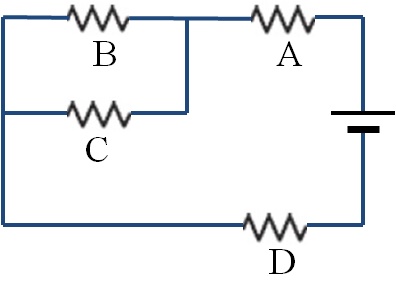
Question: 4. A circuit contains a battery and four identical resistors arranged as shown in the diagram below.
(a) Rank the electrical potential difference across each resistor in descending order. If any resistors have potential differences with the same magnitude, state that explicitly. Explain your answer.

(b) When resistor B is removed in the electrical circuit, what happens to the electric current through resistor A? Explain your answer.

(c) When resistor B is removed in the electrical circuit, what happens to the electric current through resistor C? Explain your answer. 

Scoring Guidelines
(a) Ranking: RA = RD > RB = RC
Indicate that the electrical potential difference is the same in RA and RD because the electric current is the same through RA and RD. [1 mark] 
Indicate that the electrical potential difference is the same in RB and RC because RB and RC are in parallel. [1 mark] 
Indicate that the electrical potential difference is less in RB (and/or RC) than in RA (and/or RD) because the electric current splits through RB and RC. [1 mark] 

(b) Indicate that the effective resistance of the circuit increases. [1 mark] 
Explain correctly why the electric current through RA decreases because of the change in electric current or electrical potential difference in the circuit. [1 mark] 

(c) Indicate that the electric current through the battery is the same as electric current through RC and there is no splitting of electric current. [1 mark] 
(https://secure-media.collegeboard.org/digitalServices/pdf/ap/apcentral/ap16_physics_1_q4.pdf)

Possible answers:
The electrical circuit can be redrawn as follows;
(a) Let the electromotive force of the battery be E and the resistance of each resistor be r. Total resistance = RA + RB,C + RD = r + r/2 + r = 5r/2. 
By using Ohm’s law, I = V/R = E/(5r/2) = (2/5)(E/r) = 0.40 (E/r). 
Thus, ΔVA = ΔVD = Ir = 0.40 E and ΔVB = ΔVC = 0.20 E. 
The ranking of electrical potential difference can be presented as follows: 
ΔVA = ΔVD > ΔVB = ΔVC. 

(b) After removing the resistor B, the electrical circuit can be redrawn as follows:
Total resistance = RA + RC + RD = r + r + r = 3r. 
Electric current, Ia = V/R = E/3r = 0.33 (E/r). 
The electric current is decreased from 0.40 (E/r) to 0.33 (E/r). 
Thus, the answer is “decrease.” 

(c) The electric current through resistor C also equals to 0.33 (E/r) because the three resistors A, B, and C are in series and have the same resistance r
However, the electric current through resistor C in the original circuit is IA/2 = 0.20 (E/r) because the electric current through resistor A is equally split in resistor C and resistor B. 
The electric current is increased from 0.20 (E/r) to 0.33 (E/r). 
Thus, the answer is “increase.” 

Feynman’s insights or goofs?
In Feynman’s own words, “[t]he second kind of circuit element is called a resistor; it offers resistance to the flow of electrical current. It turns out that metallic wires and many other substances resist the flow of electricity in this manner: if there is a voltage difference across a piece of some substance, there exists an electric current I = dq/dt that is proportional to the electric voltage difference: V = RI = Rdq/dt. The proportionality coefficient is called the resistance R. This relationship may already be familiar to you; it is Ohm’s law (Feynman et al., 1963, section 23–3 Electrical resonance).” Essentially, Feynman explains that Ohm’s law is about the mathematical relationship, V = RI = Rdq/dt. However, some physics educators may not like the phrase “flow of electric current” as used by Feynman. This is because electric current is a flow of charge carriers and thus, the flow of electric current is “the flow of flow of charge carriers.”

In his Nobel lecture, Wilczek (2004) humorously says that “Ohm’s first law is V = IR. Ohm’s second law is I = V/R. I’ll leave it to you to reconstruct Ohm’s third law (p. 413).” Historically speaking, there are at least two different versions of Ohm’s Law: ‘the law for a part of a circuit’ and ‘the law for a whole circuit’ (Ashford and Kempson 1908; Kipnis 2009). Ohm’s law for a part of a circuit means that an electric current through an electrical conductor is directly proportional to the potential difference across the conductor, and the resistance of the conductor is assumed to be constant. This version of Ohm’s law can be represented by the equation, I ΔV/R. Alternatively, Ohm’s law for a whole circuit means that an electric current through a conductor is directly proportional to the potential difference across the conductor and it is inversely proportional to its resistance. This version of Ohm’s laws can be represented by the following equation, I = E/(R + r), in which E is the electromotive force of a power supply and r is the internal resistance of the power supply. 

To be more precise, Ohm’s law can be defined by stating the operating conditions such as the electric current is not too high. When the electrical current is sufficiently high, this can lead to a significant heating effect. First, a heating of the electrical conductor may increase the temperature of the conductor. Second, the increase in temperature can result in an increase in the length of the conductor. Third, when the temperature of the conductor is being increased, the electrical resistance is also increased, and this can lead to a reduction in the electric current through the conductor. Thus, Ohm’s law does not always hold because electrical properties of the conductor are dependent on the operating conditions. 

References
1. Ashford, C. E., & Kempson, E. W. E. (1908). The elementary theory of direct current dynamo electric machinery. Cambridge: The University Press. 
2. Feynman, R. P., Leighton, R. B., & Sands, M. (1963). The Feynman Lectures on Physics, Vol I: Mainly mechanics, radiation, and heat. Reading, MA: Addison-Wesley. 
3. Kipnis, N. (2009). A Law of Physics in the Classroom: The Case of Ohm’s Law. Science & Education, 18(3-4), 349-382. 
4. Wilczek, F. (2004). Asymptotic freedom: From Paradox to Paradigm. In F., Wilczek, & B., Devine, (Eds.). (2006). Fantastic Realities: 49 Mind Journeys and a Trip to Stockholm. Singapore: World Scientific.